
Introduction
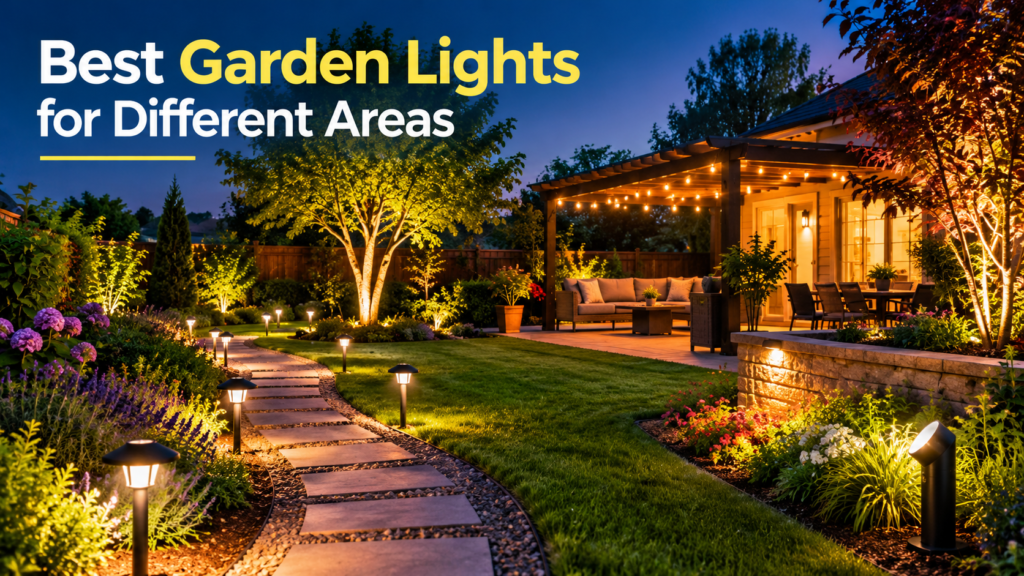
The best garden lights for different areas can transform your outdoor space into a beautiful, safe, and welcoming place after dark. From illuminating pathways and highlighting trees to creating a cozy atmosphere around patios, the right lighting makes your garden more attractive and functional. In this guide, you’ll learn how to choose suitable garden lights for different areas, compare lighting options, and create a balanced layout that fits your garden and budget.
Table of Contents
## What Are the Best Garden Lights for Different Areas?
**The best garden lights for different areas depend on the size of your garden, how you use each space, the brightness you need, and your preferred power source. The right lighting can make pathways safer, highlight beautiful plants, create a relaxing patio, and improve visibility around entrances.**
**Before choosing garden lights, think about the purpose of each area. Pathways need clear, even lighting, while flower beds and trees often look better with soft accent lights. Patios and seating areas benefit from warm lighting that creates a comfortable atmosphere.**
**There are several types of garden lights to consider:**
**Solar garden lights: These are easy to install because they usually do not require electrical wiring. They work well along pathways, around flower beds, and in areas that receive enough direct sunlight.**
**LED garden lights: LED lights are energy-efficient, long-lasting, and available in many brightness levels and styles. They are suitable for almost any garden area.**
**Low-voltage garden lights: These lights use a transformer to reduce mains electricity to a lower voltage, commonly 12V. They are a good choice for pathways, patios, flower beds, and landscape accent lighting when installed with suitable outdoor-rated equipment.**
**Mains-powered garden lights: These provide a reliable power supply and are useful for permanent lighting, entrances, security areas, and larger gardens. Outdoor electrical installations should be weather-protected and completed by a qualified electrician where required.**
**Garden size also matters. A small garden may only need a few carefully positioned wall lights, solar stakes, or spotlights. A larger garden may benefit from separate lighting zones for paths, trees, seating areas, and boundaries.**
**Brightness is another important factor. Choose enough light to see steps and walkways clearly, but avoid lighting every corner too brightly. Warm white light, usually around 2700K–3000K, is ideal for relaxing spaces, while brighter or more neutral light may be useful where visibility and security are priorities.**
## Best Garden Lights for Different Areas of Your Garden
**Different parts of your garden have different lighting needs. The following ideas will help you choose suitable fixtures for each area while balancing appearance, safety, energy efficiency, and practicality.**
**For reliable results, choose lights based on the specific needs of each space rather than using the same fixture everywhere. Solar lights are convenient where sunlight is available, while low-voltage systems are useful when you need more consistent lighting across several areas.**
**The Home Depot**
**+1**
### 1. Best Garden Lights for Pathways and Walkways
**The best garden lights for pathways and walkways provide enough illumination to help people see where they are going without creating glare. They also make garden paths look more attractive after sunset.**
**Solar pathway lights: These lights are easy to install and work well along garden paths that receive plenty of sunlight during the day. They are a good option if you want to avoid wiring.**
**Low-voltage LED path lights: These offer consistent illumination and are suitable for paths that need reliable lighting throughout the evening.**
**Bollard lights: These are short, upright fixtures that spread light across pathways and nearby planting areas. They work particularly well in modern gardens and along wider walkways.**
**Recommended placement and spacing: Place path lights along the edges of walkways, staggering them on alternate sides for a natural look. As a starting point, space them around 6–10 feet apart, then adjust according to the brightness, beam spread, and path width. Place lights closer together near steps, bends, and uneven surfaces where extra visibility is needed.**
### 2. Best Garden Lights for Flower Beds and Borders
**The best garden lights for flower beds and borders highlight colorful flowers, attractive foliage, and the shape of your garden without overwhelming the plants.**
**Small spotlights: Use these to highlight individual flowers, ornamental grasses, or interesting shrubs. Choose adjustable models so you can direct the beam where it looks best.**
**Spike lights: These are easy to position in soil and can be moved as plants grow or your garden design changes.**
**Low-level solar lights: These create a soft glow along garden borders and are suitable for decorative lighting in sunny areas.**
**Position lights slightly away from delicate plants and angle them toward the foliage rather than directly into people’s eyes. A combination of gentle lighting and darker spaces creates depth and makes the garden look more natural.**
**Avoid placing too many lights close together, as excessive brightness can hide the natural colors and textures of flowers.**
### 3. Best Garden Lights for Trees and Tall Plants
**Trees and tall plants can become attractive focal points when illuminated from the ground. The best garden lights for these areas emphasize the shape of trunks, branches, leaves, and ornamental plants.**
**LED uplighters: These shine upward from the ground and are ideal for highlighting tree trunks, tall grasses, and large shrubs.**
**Adjustable spotlights: These allow you to direct light toward a particular branch, section of foliage, or tree canopy.**
**In-ground lights: These sit flush with the ground and provide a neat appearance around trees, subject to suitable drainage and outdoor ratings.**
**For a dramatic effect, position a spotlight near the base of a tree and angle it upward. Larger trees may benefit from two lights placed at different angles, while smaller trees often need only one.**
**You can also experiment with shadows by directing light through branches toward a nearby wall or fence. Choose a beam angle that suits the tree’s height and spread, and avoid shining lights directly into windows or neighboring properties.**
### 4. Best Garden Lights for Patios and Seating Areas
**Patios and seating areas need comfortable lighting for relaxing, dining, and entertaining. The best garden lights for these spaces provide enough visibility without making the area feel harsh or overly bright.**
**Warm-white LED lights: Lights around 2700K–3000K create a welcoming atmosphere around outdoor tables, chairs, and lounge areas.**
**Solar lanterns: These offer flexible decorative lighting and can be placed on tables, steps, or side stands.**
**Wall lights: Outdoor-rated wall lights provide practical illumination around patio doors, seating areas, and nearby walkways.**
**Low-voltage ambient lighting: These systems can provide consistent light around larger patios and outdoor seating zones.**
**Combine different lighting levels for the best result. Wall lights can provide general illumination, while lanterns and smaller decorative fixtures add a softer glow. If you have an outdoor dining table, position the main light so that people can see their food without being dazzled.**
**Choose dimmable lights where possible so you can adjust the brightness for dining, entertaining, or relaxing.**
### 5. Best Garden Lights for Pergolas and Gazebos
**Pergolas and gazebos are ideal places for decorative garden lighting. The right fixtures can create a comfortable atmosphere for outdoor dining, evening gatherings, or quiet relaxation.**
**Outdoor string lights: Hang these along pergola beams or around the roof structure to create a warm, inviting glow.**
**Outdoor-rated hanging pendant lights: These work well over dining tables and seating areas when the structure can safely support them.**
**LED festoon lights: These larger decorative bulbs add character to outdoor entertaining spaces and can be installed along beams or suitable support wires.**
**Choose outdoor-rated fixtures and bulbs designed to withstand the conditions in your garden. Secure cables properly and keep them away from sharp edges, hot surfaces, and areas where people might trip.**
**For a balanced appearance, use string lights as the main decorative feature and add a few low-level lights nearby for practical visibility. Avoid using too many bright fixtures, which can make a pergola feel less relaxing.**
### 6. Best Garden Lights for Lawns and Open Spaces
**Large lawns and open garden spaces can look dark if lighting is concentrated only around the edges. The best garden lights for these areas highlight important features without illuminating every part of the lawn.**
**Spike spotlights: Use these to highlight ornamental trees, sculptures, large shrubs, or other focal points around the lawn.**
**Low-level bollard lights: These can define the edges of a walkway that crosses an open space or borders a lawn.**
**Decorative solar lights: These add gentle accents around lawn edges and planting beds without requiring extensive wiring.**
**Instead of placing bright lights throughout the lawn, focus on the features you want people to notice. A few well-positioned spotlights can create depth and make an open garden feel more interesting.**
**Keep the center of the lawn relatively dark if it does not need functional lighting. This creates contrast, saves energy, and helps the illuminated areas stand out.**
### 7. Best Garden Lights for Fences and Garden Boundaries
**Garden boundary lighting helps define the shape of your outdoor space, improves visibility, and adds decorative detail to fences and walls.**
**Solar fence lights: These are convenient for wooden fences, boundary walls, and garden edges where the panels receive adequate sunlight.**
**Outdoor wall lights: These provide more consistent illumination and work well on masonry walls, garage walls, and other suitable surfaces.**
**Low-voltage boundary lighting: This is useful for creating a coordinated lighting system along longer fences and garden boundaries.**
**Place lights at regular intervals to create a balanced appearance. You can use downward-facing fixtures to illuminate the ground near a fence or softer accent lights to highlight textured walls and attractive materials.**
**For security and comfort, direct light into your garden rather than toward neighboring windows. If the boundary is long, consider illuminating selected sections instead of lighting the entire fence equally.**
### 8. Best Garden Lights for Steps and Stairs
**Steps and stairs require lighting that clearly reveals each step’s edge and any changes in level. The best garden lights for these areas improve nighttime visibility while minimizing glare.**
**Recessed step lights: These can be installed into suitable step risers or nearby walls for a clean, unobtrusive appearance.**
**LED wall lights: These provide practical illumination when positioned beside outdoor stairs and steps.**
**Low-glare surface-mounted lights: These are useful when recessed installation is not practical and can be fitted to suitable walls or step structures.**
**Position lights so they illuminate the walking surface and the front edge of each step. Avoid placing a bright fixture where it shines directly into someone’s eyes as they walk up or down.**
**Choose durable, weather-resistant fixtures suitable for the installation location. For wired lighting, ensure that the electrical system is appropriately protected for outdoor use.**
### 9. Best Garden Lights for Ponds and Water Features
**Water features can become striking focal points when illuminated carefully. The best garden lights for ponds and fountains highlight moving water, reflections, and surrounding plants without creating excessive glare.**
**Submersible pond lights: These are designed specifically for underwater use and must have the appropriate rating and installation method for the depth and conditions of the pond.**
**Spotlights for fountains and waterfalls: Position suitable outdoor spotlights to highlight flowing water from the side or below, where the equipment allows.**
**Reflected lighting effects: Aim lights toward a waterfall, textured stone, or nearby foliage to create soft reflections across the water.**
**Use only fixtures explicitly rated for the intended underwater or wet location. Underwater lighting has specific electrical safety requirements, so follow the manufacturer’s instructions and local regulations, and use a qualified electrician where required. Keep connections and power supplies protected from water, and never assume that a general outdoor light is safe to submerge.**
**Soft, carefully directed light often produces a more attractive result than a very bright fixture aimed directly across the pond.**
### 10. Best Garden Lights for Garden Entrances and Front Gardens
**Garden entrances and front gardens benefit from lighting that combines appearance, visibility, and security. The right fixtures can make an entrance easier to navigate while improving the overall look of your property.**
**Solar entrance lights: These are easy to install near gates, garden entrances, and paths when the location receives sufficient sunlight.**
**Wall-mounted lanterns: These create a welcoming appearance around entrances, exterior doors, and garden walls.**
**Low-voltage path lights: These provide consistent illumination along walkways leading to the entrance.**
**Place lights near gates, changes in level, and the beginning of pathways. Choose fixtures that make the entrance easy to identify without producing excessive brightness or glare.**
**For added security, consider motion-sensor lights in areas where you need light only when someone approaches. Use outdoor-rated fixtures and ensure that the brightness is appropriate for the surrounding homes and pathways.**
### 11. Best Garden Lights for Backyards
**Backyards often serve several purposes, including relaxing, entertaining guests, gardening, and outdoor dining. The best garden lights for backyards combine practical illumination with decorative lighting to make the space useful after sunset.**
**String lights: These work well over patios, decks, seating areas, and suitable garden structures.**
**Garden spotlights: Use them to highlight trees, architectural features, or attractive planting areas.**
**Solar stake lights: These are easy to move and can illuminate flower beds, lawn edges, and garden paths.**
**Divide your backyard into zones based on how you use each area. For example, use brighter task lighting near an outdoor cooking area, warm string lights over seating, and subtle spotlights around trees and shrubs.**
**Layering several types of lighting creates a more balanced effect than relying on a single bright fixture. If you have a large backyard, use separate switches, timers, or smart controls so you can illuminate only the areas you need.**
### 12. Best Garden Lights for Small Gardens
**Small gardens need carefully planned lighting because too many fixtures can make the space feel crowded. The best garden lights for small gardens highlight key features, improve visibility, and create a sense of depth without taking up too much room.**
**Compact solar lights: These are suitable for small paths, pots, and garden borders where enough sunlight is available.**
**Wall-mounted lights: These provide useful illumination without occupying valuable ground space.**
**Small LED spotlights: Use these to highlight a feature plant, a small tree, a textured wall, or an attractive planter.**
**Choose a few focal points instead of illuminating every corner. For example, one spotlight on a small tree, two or three path lights, and a wall light near a seating area may provide enough illumination for a compact garden.**
**Use warm-white lighting to create a welcoming atmosphere, and position fixtures to draw the eye toward the back of the garden. This can help the space feel deeper. Avoid oversized bollards, excessive brightness, and too many different lighting styles.**
## How to Choose the Best Garden Lights for Different Areas
**Choosing the best garden lights for different areas helps you create a garden that looks attractive, feels comfortable, and stays safe after dark. The right lighting depends on the purpose of each area, such as illuminating pathways, highlighting plants, lighting patios, or improving visibility near entrances.**
**Before buying garden lights, consider the brightness, light color, power source, weather resistance, and installation requirements. Using different types of lighting in the right places can make your outdoor space more practical and inviting.**
### 1. Choose the Best Garden Lights for Pathways and Walkways
**delislandscaping.com**
**Pathways and walkways need lighting that helps people see where they are walking and avoid obstacles. The best garden lights for these areas provide even illumination without creating glare.**
**Solar pathway lights: Ideal for simple installations without wiring. Place them where the solar panels receive sufficient sunlight.**
**Low-voltage LED path lights: Offer reliable illumination and are suitable for frequently used walkways.**
**Bollard lights: Provide wider light coverage along larger paths and garden entrances.**
**Recessed ground lights: Create a clean, modern appearance when installed correctly.**
**Place path lights approximately 6–10 feet apart as a starting point, adjusting the spacing according to brightness, beam spread, and the shape of the path. Staggering lights on alternate sides can create a more natural look than placing them in a straight line.**
### 2. Select Garden Lights for Flower Beds and Borders
**weedman.com**
**Flower beds and garden borders look more attractive when lighting highlights their colors, shapes, and textures. Choose fixtures that illuminate the plants without overpowering them.**
**Small spotlights: Highlight individual flowers, ornamental grasses, and attractive plants.**
**Low-level garden lights: Define borders and create a soft glow along planting areas.**
**Solar garden lights: Work well in sunny borders where installing cables is inconvenient.**
**Adjustable LED spotlights: Allow you to direct light toward specific plants as the garden grows.**
**Warm white lighting between 2700K and 3000K is a good choice for most flower beds because it creates a natural, welcoming appearance. Avoid positioning lights directly toward seating areas or windows, as this can cause glare.**
### 3. Choose the Best Garden Lights for Trees and Shrubs
**gardenuk.co.uk**
**Trees and shrubs can become attractive focal points when illuminated from the correct angle. The best garden lights for these areas depend on the plant’s size, shape, and location.**
**Uplighters: Place these near the base of trees to highlight trunks, branches, and foliage.**
**Spotlights: Direct them toward specific branches or shrubs to emphasize their shape.**
**Well lights: Install suitable recessed fixtures at ground level for a discreet appearance.**
**Adjustable landscape lights: Make it easier to change the beam direction as plants grow.**
**Use narrow beams for tall trees and wider beams for large shrubs or spreading branches. Position the fixtures so that the light highlights the plant rather than shining directly into people’s eyes.**
### 4. Select Garden Lights for Patios and Seating Areas
**myholidayexpressions.com**
**Patios and seating areas need comfortable lighting for relaxing, entertaining guests, and enjoying meals outdoors. Avoid lighting that is too bright or harsh, as it can make the space feel less inviting.**
**String lights: Create a decorative atmosphere above seating areas and dining tables.**
**Outdoor wall lights: Provide practical illumination near doors and covered patios.**
**LED lanterns: Add flexible decorative lighting to tables and seating corners.**
**Dimmable lights: Allow you to adjust brightness for dining, relaxing, or entertaining.**
**Warm white light around 2700K–3000K is usually the best choice for patios. Use brighter task lighting near outdoor cooking or food preparation areas when needed.**
**Choose weather-resistant fixtures suitable for their exposure to rain and moisture.**
### 5. Choose Garden Lights for Entrances and Front Gardens
**liteshine.com.au**
**Front gardens and entrances benefit from lighting that improves visibility and creates a welcoming first impression. Focus on doorways, steps, paths, and important architectural features.**
**Wall-mounted lights: Illuminate entrances, doorways, and exterior walls.**
**Pathway lights: Help visitors navigate the route to your front door.**
**Motion-sensor lights: Provide extra illumination when someone approaches.**
**Low-level spotlights: Highlight trees, planters, and attractive landscaping.**
**Choose brighter lighting where people need to identify steps, locks, or obstacles. Keep decorative lighting softer to maintain a balanced appearance.**
**Avoid directing lights toward neighboring homes or passing traffic. Motion sensors and timers can also help reduce unnecessary energy use.**
### 6. Select the Best Garden Lights for Backyards
**cityblooming.com**
**Backyards often contain several different areas, including lawns, planting beds, patios, and relaxation spaces. The best garden lights for a backyard combine practical lighting with decorative accents.**
**Consider using:**
**Floodlights: Illuminate larger areas when stronger visibility is required.**
**Spotlights: Highlight trees, sculptures, and other focal points.**
**String lights: Create a cozy atmosphere around seating and dining spaces.**
**Path lights: Illuminate routes between different parts of the garden.**
**Solar lights: Provide convenient lighting in areas without easy access to power.**
**Rather than illuminating the entire backyard equally, focus on the areas you use most often. Combine brighter functional lighting with softer accent lighting to create depth and avoid excessive brightness.**
### 7. Choose Garden Lights for Fences and Garden Boundaries
**mr-resistor.co.uk**
**Fence and boundary lighting helps define the garden’s edges and makes outdoor spaces look more complete after dark.**
**Fence-mounted lights: Illuminate boundary areas without taking up ground space.**
**Solar fence lights: Offer a convenient option where the fence receives enough sunlight.**
**Low-voltage LED lights: Provide consistent illumination along longer boundaries.**
**Ground spotlights: Highlight fence textures, nearby plants, or decorative features.**
**Use evenly spaced fixtures for a balanced appearance, but avoid placing too many lights close together. Soft, downward-facing light can define the boundary while reducing glare and light spill into neighboring properties.**
### 8. Select Garden Lights for Pergolas and Outdoor Dining Areas
**superledlights.co.uk**
**Pergolas and outdoor dining areas benefit from lighting that creates a comfortable atmosphere while providing enough visibility for eating and socializing.**
**Suitable options include:**
**String lights: Hang them across pergola beams for decorative ambient lighting.**
**Pendant lights: Provide focused illumination above dining tables when the installation is suitable for outdoor use.**
**Dimmable LED lights: Help you adjust brightness for different occasions.**
**Recessed pergola lights: Offer a neat, integrated appearance.**
**Choose outdoor-rated fixtures and suitable mounting hardware. Secure cables properly, keep electrical connections protected from moisture, and follow the manufacturer’s installation instructions.**
### 9. Choose Garden Lights for Ponds and Water Features
**gazonexpert.ru**
**Ponds, fountains, and other water features can become striking focal points with carefully positioned lighting. However, these areas require extra attention to electrical safety.**
**Pond lights: Designed specifically for installation in or around water, according to their ratings.**
**Waterproof spotlights: Highlight waterfalls, fountains, and surrounding plants.**
**Low-voltage landscape lights: Can illuminate nearby paths and pond edges when installed correctly.**
**Subtle accent lights: Create reflections and emphasize the shape of the water feature.**
**Always check the fixture’s suitability for its exact location. Lights installed underwater require equipment specifically rated for that purpose, and electrical systems must have appropriate protection and installation. Consult a qualified electrician when wiring near water.**
### 10. Consider Solar, Low-Voltage, and Mains-Powered Garden Lights
**The power source is another important factor when choosing the best garden lights for different areas.**
**Light type**
**Main advantages**
**Best suited for**
**Solar lights**
**Easy installation and no mains wiring at the fixture**
**Sunny paths, borders, and decorative areas**
**Low-voltage LED lights**
**Consistent lighting with relatively low energy use**
**Paths, patios, trees, and garden borders**
**Mains-powered lights**
**Suitable for fixtures requiring higher or continuous power**
**Entrances, security lighting, and some large outdoor areas**
**Solar lights depend on daylight, battery condition, and weather, so they may provide less illumination during winter or cloudy periods. Low-voltage and mains-powered systems require suitable installation, and mains outdoor wiring should be handled by a qualified electrician.**
**For most gardens, a combination of solar and low-voltage LED lighting offers a useful balance of convenience, appearance, and performance.**
### 11. Consider Brightness, Color, and Weather Resistance
**Before purchasing, check the brightness, color temperature, and weather protection of each fixture.**
**Brightness: Lumens indicate the amount of light a fixture produces. Choose enough light for safe movement without making the garden uncomfortably bright.**
**Color temperature: Warm white light (2700K–3000K) suits seating areas, plants, and decorative features. Neutral or cooler light may be appropriate for some entrances and security applications.**
**Weather resistance: Check the IP rating and whether the fixture is suitable for its intended exposure to rain, dust, or standing water.**
**Energy efficiency: LED fixtures generally use less electricity than comparable traditional lighting.**
**Controls: Timers, motion sensors, and dimmers can improve convenience and reduce unnecessary use.**
**Remember that an IP rating alone does not establish that a fixture is safe for underwater use or every outdoor condition. Always follow the product’s specifications.**
**12. Common Mistakes to Avoid When Choosing Garden Lights**
**Avoid these mistakes to make your garden lighting more effective and attractive:**
**Installing too many lights and making the garden excessively bright.**
**Choosing fixtures without checking their outdoor weather rating.**
**Using solar lights in heavily shaded locations.**
**Ignoring the brightness and beam angle required for each area.**
**Placing spotlights where they shine directly into people’s eyes.**
**Using different light colors that clash with each other.**
**Overlooking cable protection and electrical safety.**
**Forgetting to consider maintenance, battery replacement, and energy use.**
**Planning the layout before purchasing fixtures can help you avoid unnecessary expenses and achieve a more balanced result.**
### Final Tips for Choosing the Best Garden Lights for Different Areas
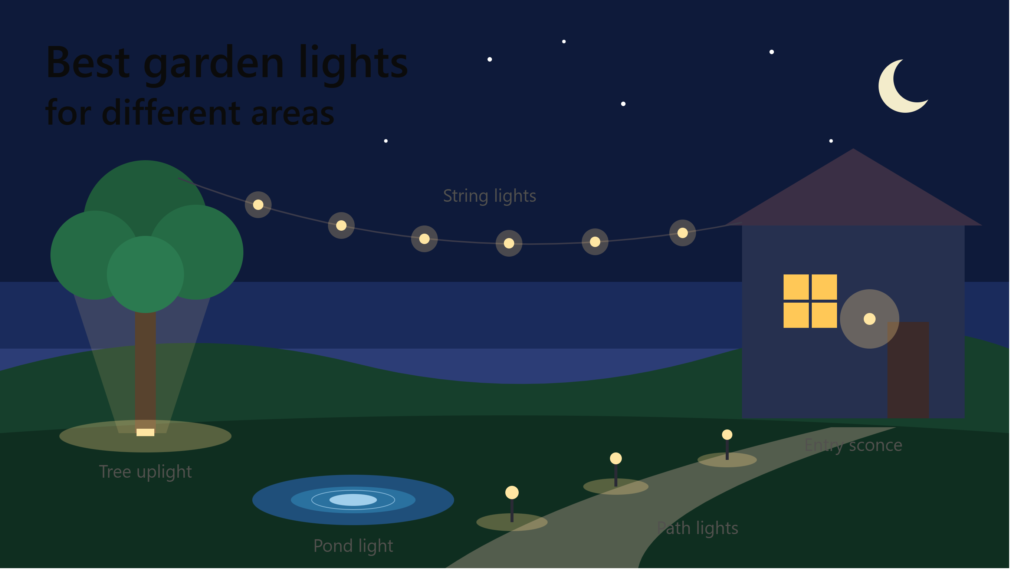
**The best garden lights for different areas are those that match the purpose of each space. Use pathway lights for safe movement, spotlights and uplighters to highlight plants, warm string lights for patios, and suitable wall or motion-sensor lights for entrances.**
**Before installing anything, plan the layout, check the available sunlight or power supply, and choose fixtures rated for outdoor conditions. Start with the most important areas, test the lighting after dark, and adjust the positions and brightness as needed.**
**A thoughtful combination of functional and decorative lighting can make your garden safer, more attractive, and more enjoyable throughout the evening.**
### Choose the Right Lighting Purpose
**When choosing the best garden lights for different areas, start by deciding what you want each light to do. Some lights create a relaxing atmosphere, while others improve visibility, highlight plants, or increase security. Understanding these purposes helps you choose suitable fixtures and avoid wasting energy.**
### 1. Ambient Lighting
**Ambient lighting provides soft, general illumination across your garden. It makes outdoor spaces feel welcoming and comfortable without creating harsh brightness.**
**Good options include garden lanterns, string lights, low-level bollard lights, and diffused LED fixtures. Use ambient lighting around patios, seating areas, pergolas, and outdoor dining spaces.**
**Warm white light between 2700K and 3000K is usually ideal for creating a cozy atmosphere. Spread the lights evenly to avoid dark patches and overly bright spots.**
### 2. Task Lighting
**Task lighting provides focused illumination for activities that require good visibility. It is useful in areas where you cook, prepare food, read, or move along steps and pathways.**
**Suitable options include LED wall lights near outdoor kitchens, lights above dining tables, and well-positioned fixtures around steps and entrances. Choose a brightness level that makes the activity easy without causing glare.**
### 3. Accent Lighting
**Accent lighting highlights attractive features such as trees, flower beds, garden sculptures, and water features. It adds depth and visual interest to your garden after dark.**
**Use adjustable spotlights, uplighters, recessed ground lights, or small LED fixtures to highlight specific features. Direct the beams carefully to create attractive shadows without shining light into seating areas or neighboring properties.**
**For a natural appearance, use warm white lighting and highlight a few important features rather than illuminating everything equally.**
### 4. Security Lighting
**Security lighting improves visibility around entrances, gates, driveways, garages, and other access points. It can also make it easier to identify obstacles when moving around the property at night.**
**Motion-sensor floodlights, outdoor wall lights, and suitable LED security fixtures are useful choices. Position them to cover important areas while avoiding direct glare toward windows, roads, and neighboring homes.**
**Choose brighter lighting where visibility is important, and consider motion sensors or timers to reduce unnecessary energy use.**
## Compare Solar, LED, Low-Voltage, and Mains-Powered Lights
**The power source and lighting technology affect installation, brightness, running costs, and maintenance. Comparing these factors helps you choose the best garden lights for different areas of your outdoor space.**
**Light type**
**Installation requirements**
### Brightness
**Running costs**
**Maintenance and reliability**
**Solar lights**
**Usually simple, with no mains wiring at the fixture**
**Varies with sunlight and battery capacity**
**Very low electricity cost**
**Panels need cleaning; batteries eventually need replacement**
**LED lights**
**Depends on whether the fixture is solar, low-voltage, or mains-powered**
**Available in a wide range of brightness levels**
**Generally low electricity use**
**Long-lasting LEDs, with occasional cleaning and component checks**
**Low-voltage lights**
**Require a compatible transformer and suitable outdoor wiring**
**Usually consistent when correctly installed**
**Generally low with LED fixtures**
**Check cables, connectors, transformers, and fixtures.**
**Mains-powered lights**
**Require suitable outdoor electrical installation**
**Suitable options range from decorative to high-output lighting.**
**Depends on wattage and operating hours**
**Reliable when correctly installed, with routine inspections**
**Remember that LED describes a lighting technology, while solar, low-voltage, and mains-powered describe power arrangements. A light can be both LED and solar-powered or LED and mains-powered.**
### Installation Requirements
**Solar lights are usually the easiest to install because most models do not need electrical wiring. They are suitable for garden borders, pathways, and decorative features that receive enough sunlight.**
**Low-voltage systems require a compatible transformer and outdoor-rated cables. They work well for paths, trees, and flower beds where consistent lighting is important.**
**Mains-powered lighting is useful for certain security fixtures and larger installations, but outdoor wiring requires appropriate protection and should be installed by a qualified electrician.**
### Brightness
**Solar lights can provide sufficient illumination for decorative features and lightly used pathways, but their output and runtime depend on sunlight, battery condition, and design.**
**Low-voltage LED lights provide dependable illumination for most garden areas. Mains-powered fixtures are available in a wide range of outputs, including brighter floodlights for security and large spaces.**
**Check lumens rather than relying only on wattage when comparing brightness.**
### Running Costs
**Solar lights generally have very low running costs because they use sunlight to recharge their batteries. LED lights also help reduce electricity consumption compared with less efficient lighting technologies.**
**For wired lights, actual running costs depend on their wattage, electricity price, and how many hours they operate. Timers, motion sensors, and dimmers can help reduce unnecessary use.**
### Maintenance and Reliability
**Solar lights need clean panels, functioning batteries, and sufficient daylight. Their performance may decline during cloudy weather or winter.**
**Low-voltage and mains-powered systems need occasional checks of connections, cables, and weather seals. LED fixtures generally require less frequent bulb replacement than traditional incandescent lighting.**
## Choose the Right Brightness and Color Temperature
**Brightness and color temperature influence both the appearance and usefulness of your garden lighting. Choose fixtures according to the activity, surrounding environment, and atmosphere you want to create.**
### Warm White for Relaxing Spaces
**Warm white light, usually around 2700K–3000K, creates a comfortable and inviting atmosphere. It works particularly well around patios, outdoor seating, pergolas, flower beds, and decorative trees.**
**This color temperature complements natural materials such as wood, brick, and stone. It is also a good choice when you want the garden to feel calm rather than brightly illuminated.**
### Neutral White for Practical Visibility
**Neutral white light, approximately 3500K–4000K, provides a clearer, less yellow appearance. It can be suitable for outdoor work areas, utility spaces, and some entrances where practical visibility matters.**
**However, neutral white is not necessary everywhere. Using warmer lighting in relaxing areas and neutral lighting where needed creates a more balanced result.**
### Brighter Light for Entrances and Security
**Entrances, gates, steps, and driveways may need brighter lighting to help people see obstacles clearly. Choose fixtures with enough lumens and an appropriate beam angle to cover the intended area.**
**Motion-sensor lights can provide stronger illumination when someone approaches. Avoid selecting an unnecessarily powerful fixture, as excessive brightness can create harsh shadows and reduce comfort.**
### Avoiding Glare and Excessive Brightness
**Too much light can make a garden uncomfortable and cause light to spill into neighboring properties. Prevent this by using shielded fixtures, directing beams downward where practical, and spacing lights carefully.**
**Use lower brightness for decorative features and stronger illumination only where it serves a clear purpose. Test the arrangement after dark and adjust fixture angles if the light is too intense.**
## Check Weather Resistance and IP Ratings
**Outdoor garden lights must withstand the weather conditions in which they are installed. Rain, dust, humidity, and standing water can damage unsuitable fixtures, so check the IP rating and the manufacturer’s installation instructions before buying.**
### Suitable Ratings for Exposed Garden Fixtures
**An IP rating indicates protection against solid particles and water. The first digit refers to protection against solids, while the second refers to protection against water.**
**IP rating**
**General protection**
**Typical consideration**
**IP44**
**Protection against solid objects of 1 mm or larger and water splashes**
**Sheltered outdoor locations where the manufacturer permits**
**IP65**
**Dust-tight and protected against water jets**
**Exposed fixtures requiring stronger dust and water protection**
**IP67**
**Dust-tight and protected against temporary immersion under specified test conditions**
**Certain locations where temporary immersion is a risk, subject to product instructions**
**These ratings are not interchangeable, and the correct choice depends on the fixture’s location and exposure.**
### Protection from Rain, Dust, and Moisture
**Choose outdoor-rated fixtures for exposed pathways, garden borders, fences, and patios. Keep connectors properly sealed and avoid leaving cable joints in areas where water can collect.**
**Inspect weather seals periodically, particularly after severe weather. Even a fixture with a suitable IP rating can fail if its seals are damaged or it is installed incorrectly.**
### Special Requirements for Pond and Underwater Lighting
**Ponds and fountains need additional care because ordinary outdoor lighting is not necessarily safe for immersion. Choose fixtures specifically designed and rated for underwater use at the intended depth and conditions.**
**Electrical supplies must have suitable protection, and wiring arrangements must comply with local electrical requirements. Consult a qualified electrician for installations near water, especially where mains electricity is involved.**
## Consider Energy Efficiency and Maintenance
**Energy efficiency and routine maintenance help keep garden lighting reliable while reducing long-term costs. When comparing the best garden lights for different areas, consider not only the initial purchase price but also their operating requirements.**
### LED Energy Savings
**LED garden lights generally use less electricity than comparable traditional incandescent lights and have a longer operating life. They are available for pathways, patios, trees, borders, entrances, and security applications.**
**Choose an LED fixture with the brightness you need rather than buying the highest-output model. Timers, dimmers, and motion sensors can further reduce energy consumption when compatible with the fixture.**
### Solar Panel Positioning
**Solar garden lights work best when their panels receive adequate direct sunlight. Place them away from heavy shade caused by trees, fences, walls, and buildings.**
**Clean the panels regularly to remove dust, leaves, and other debris. If a light becomes dim or stops working, check its position, switch, battery condition, and charging performance before replacing it.**
### Battery Replacement
**Rechargeable batteries in solar garden lights gradually lose capacity. Depending on battery chemistry, product quality, usage, and weather exposure, they may need replacement after a few years or sooner.**
**Use a compatible rechargeable battery of the type and specifications recommended by the manufacturer. Do not replace rechargeable batteries with ordinary non-rechargeable batteries unless the product explicitly permits that battery type.**
### Cleaning and Seasonal Maintenance
**Regular maintenance helps prevent dim lighting, corrosion, and premature failure.**
**Clean solar panels and light covers to remove dirt and debris.**
**Inspect cables, connectors, and fixtures for damage or corrosion.**
**Check batteries and replace worn components when necessary.**
**Remove leaves and plants that block light or shade solar panels.**
**Inspect seals and mounting hardware after storms or heavy rain.**
**Test all lights after dark to identify flickering or poorly illuminated areas.**
**Before cleaning or inspecting wired fixtures, switch off the appropriate power supply and follow the manufacturer’s safety instructions. Arrange professional repairs for damaged mains wiring.**
## How to Plan a Garden Lighting Layout
**Planning a garden lighting layout helps you place lights in the right areas, improve visibility, and create an attractive outdoor space after dark. When choosing the best garden lights for different areas, consider how you use each part of your garden and the type of lighting it needs.**
**A good layout combines practical lighting with decorative features without making the garden too bright. Follow these steps to plan your garden lighting effectively.**
### 1. Identify the Main Garden Areas
**Start by dividing your garden into different areas, such as pathways, flower beds, patios, lawns, entrances, and seating spaces. Each area may need a different type of lighting.**
**For example, pathways need enough light for safe movement, while patios benefit from softer lighting for relaxing and entertaining. Trees and flower beds can use accent lighting to highlight their shapes and textures.**
**Make a simple sketch of your garden and mark the areas you want to illuminate. This helps you estimate how many fixtures you need and avoid buying unnecessary lights.**
### 2. Highlight Paths, Entrances, Plants, and Seating Spaces
**Focus on the areas that need lighting most. Path lights can guide people along walkways, while wall lights or suitable spotlights can improve visibility near entrances.**
**Use uplighters to highlight trees, small spotlights for flower beds, and string lights around patios or pergolas. If your garden has steps or changes in ground level, provide suitable lighting to help people see potential hazards.**
**Choose fixtures according to the size and purpose of each area instead of using the same lights throughout the garden.**
### 3. Layer Ambient, Task, and Accent Lighting
**Layered lighting combines different types of illumination to create a balanced garden.**
**Ambient lighting: Provides general illumination around patios, seating areas, and pergolas.**
**Task lighting: Helps people see clearly while cooking outdoors, eating, or using steps and entrances.**
**Accent lighting: Highlights trees, shrubs, sculptures, flower beds, and water features.**
**You do not need all three types in every area. For example, a pathway may need practical path lights, while a seating area may benefit from ambient lighting and a small amount of accent lighting nearby.**
### 4. Position Lights to Avoid Glare and Dark Spots
**The position of each fixture affects how well your garden is illuminated. Place pathway lights so that their light overlaps where necessary, reducing dark gaps between fixtures.**
**Aim spotlights toward plants or garden features rather than directly toward seating areas, windows, or neighboring properties. Shielded fixtures and downward-facing beams can help control glare.**
**As a starting point, pathway lights may be spaced approximately 6–10 feet apart, but the ideal distance depends on the fixture’s brightness, beam spread, and path width.**
### 5. Test the Layout After Dark Before Final Installation
**Before permanently installing wired lights or fixing fixtures in place, test your proposed layout after sunset. Temporary placement helps you identify areas that are too bright, too dark, or poorly positioned.**
**Check whether paths and steps are clearly visible, plants are highlighted effectively, and seating areas feel comfortable. Adjust the angle and position of the lights until the garden looks balanced.**
**For solar lights, check whether the selected locations receive enough direct sunlight during the day. For wired systems, confirm cable routes and electrical requirements before installation.**
## Common Mistakes to Avoid When Choosing Garden Lights
**Even attractive fixtures can produce poor results if they are selected or installed incorrectly. Avoid these common mistakes when choosing the best garden lights for different areas.**
### 1. Using the Same Light for Every Area
**Different parts of a garden have different lighting requirements. A decorative lantern may work well beside a seating area but may not provide enough illumination for steps or a frequently used pathway.**
**Choose lights according to their purpose, such as path lights for walkways, uplighters for trees, and suitable wall or motion-sensor lights for entrances.**
### 2. Installing Lights Too Close Together
**Placing too many lights close together can create bright patches and increase installation and running costs. It can also make the garden look cluttered.**
**Follow the manufacturer’s recommended spacing and consider the beam angle of each fixture. Test the arrangement at night and adjust the distances to create more even illumination.**
### 3. Choosing Lights That Are Too Bright
**Excessively bright lights can cause glare, wash out garden details, and disturb neighbors. More brightness does not always mean better lighting.**
**Use softer illumination for decorative features and seating areas. Reserve stronger lights for locations where visibility or security is important.**
### 4. Ignoring Outdoor Weather Ratings
**Indoor lights or unsuitable outdoor fixtures may become damaged by rain, moisture, or dust. Always check the manufacturer’s specifications and IP rating before purchasing.**
**For example, IP65 fixtures are dust-tight and protected against water jets, but their suitability still depends on the installation conditions. Pond and underwater lights require products specifically designed for those environments.**
### 5. Placing Solar Panels in Heavy Shade
**Solar lights may perform poorly when their panels receive insufficient sunlight. Trees, fences, walls, and buildings can prevent batteries from charging fully.**
**Choose sunny locations whenever possible. If the light must be installed in a shaded area, consider a model with a separately positioned solar panel or use a suitable wired alternative.**
### 6. Overlooking Electrical Safety
**Outdoor electrical installations must be designed to withstand moisture and changing weather conditions. Damaged cables, poorly sealed connections, and unsuitable power supplies can create hazards.**
**Use outdoor-rated cables and connectors, suitable protective devices, and compatible transformers for low-voltage systems. Mains-powered garden lighting should be installed by a qualified electrician in accordance with local requirements.**
### 7. Adding Too Many Decorative Lights
**Too many string lights, spotlights, and colored fixtures can make a garden feel crowded and visually distracting.**
**Choose a few focal points and allow darker areas to remain between them. A balanced combination of functional lighting and subtle accents usually creates a more attractive result.**
How do I choose the best garden lights for different areas?
**Start by identifying the purpose of each area. Use path lights for walkways, uplighters for trees, spotlights for garden features, string lights for patios, and suitable wall or motion-sensor lights for entrances.**
**Consider brightness, color temperature, power source, weather resistance, and maintenance before making your final choice.**
How many garden lights do I need?
The number depends on your garden’s size, layout, and lighting requirements. A small garden may need only a few pathway lights and one or two accent fixtures, while a larger garden may require separate lighting for paths, trees, patios, and entrances.**
**Plan the layout first, then adjust the number of lights according to their brightness and beam spread.**
What is the best color temperature for garden lights?
**Warm white light around 2700K–3000K is a popular choice for patios, seating areas, flower beds, and trees because it creates a welcoming atmosphere.**
**Neutral white light around 3500K–4000K may suit practical areas where clearer visibility is useful. Choose color temperatures that complement the garden rather than mixing too many different colors.**
Are solar garden lights better than wired lights?
**Solar lights are generally easier to install and have very low electricity costs. They work well for decorative features, garden borders, and pathways that receive adequate sunlight.**
**Wired lights provide more consistent illumination and may be better for frequently used paths, entrances, and areas that need stronger or longer-lasting lighting. The right choice depends on your location, budget, and lighting needs.**
How far apart should garden lights be placed?
Pathway lights are often spaced approximately 6–10 feet apart as a starting point. Solar path lights may require closer spacing if their output is low, while brighter fixtures with wider beams may cover larger distances.**
**Always check the manufacturer’s recommendations and test the layout after dark to prevent gaps and excessive overlap.**
Should all garden lights be the same color?
No. However, using a consistent color temperature across nearby fixtures usually creates a more coordinated appearance.**
**Warm white works well for relaxing and decorative areas, while neutral white can be useful for certain practical spaces. Avoid mixing too many contrasting colors unless you specifically want a colorful decorative effect.
**Here are some general guidelines:**
**IP44: Offers protection against splashing water and solid objects of 1 mm or larger. It may suit certain sheltered locations where the manufacturer permits its use.**
**IP65: Dust-tight and protected against water jets. It is often suitable for exposed outdoor fixtures, depending on the installation.**
**IP67: Dust-tight and protected against temporary immersion under specified test conditions. It may suit certain locations where temporary immersion is a concern, but the product instructions must be followed.**
**For ordinary exposed garden areas, consider outdoor-rated LED lights with an appropriate water-protection rating. Check the manufacturer’s instructions for installation, cable connections, and exposure to rain.**
**For ponds and underwater installations, use lighting specifically designed and rated for the intended depth and conditions. An IP rating alone does not mean a fixture is suitable for permanent underwater use.**
**To improve reliability, seal cable connections correctly, avoid leaving connectors in standing water, and inspect fixtures for damaged seals or corrosion. Mains-powered lighting near water should be installed with suitable electrical protection by a qualified electrician.**
**Image suggestion: Show a weather-resistant garden spotlight illuminating plants after rainfall, with water droplets visible on the fixture.**
**Choosing the best garden lights for different areas becomes easier when you match each light to its purpose. Use practical lighting for pathways and entrances, warm ambient lighting for seating spaces, accent lights for plants, and suitable weather-resistant fixtures for exposed locations.**
**Plan your layout before purchasing, avoid excessive brightness, and test the lighting after dark. A balanced combination of functional and decorative lights can make your garden safer, more attractive, and more enjoyable throughout the even
## Conclusion
Choosing the best garden lights for different areas helps you create an outdoor space that is beautiful, safe, and functional after dark. Use pathway lights for walkways, spotlights for trees and flower beds, warm string lights for patios, and weather-resistant fixtures for exposed areas.
Consider brightness, color temperature, energy efficiency, and installation requirements before purchasing. Solar lights are ideal for simple installations, while wired LED lights provide reliable illumination where consistent lighting is important. By planning your layout carefully, avoiding glare, and selecting the right fixtures for each area, you can create a welcoming garden that looks attractive and remains enjoyable throughout the evening.